

Optimizing RF Production Testing with 1-Port VNA Solutions
March 24, 2026RF Manufacturing Trends: Moving from Full S-Parameter Testing to Targeted Measurement Strategies
As RF technologies continue to expand across communications, automotive, aerospace, and industrial markets, production testing has become a central constraint on both cost and throughput. The traditional assumption that more measurement capability is always better is increasingly being challenged in manufacturing environments, where speed, repeatability, and efficiency often outweigh the need for complete device characterization.
Vector Network Analyzers remain the standard for RF measurement, particularly during design and validation. However, in production, the requirements are often far more focused. Many devices do not require full S-parameter characterization once validated. Instead, a smaller set of measurements, most commonly reflection, is sufficient to confirm compliance with specifications.
This shift in requirements has led to renewed interest in 1-port VNA solutions. When applied correctly, these instruments do not represent a limitation but rather an optimization. Their simplified architecture, combined with modern automation and parallel measurement techniques, enables substantial improvements in throughput, cost efficiency, and production yield.
Reflection Measurements as the Foundation of Production Test
In most RF manufacturing workflows, the goal is not to fully characterize a device but to verify that it meets predefined electrical criteria. These criteria are frequently tied to impedance behavior, which makes reflection measurements a natural choice.
Return loss is a direct indicator of how well a device is matched to the system impedance. For antennas, it confirms that energy is efficiently radiated rather than reflected. For cables and connectors, it reveals discontinuities and assembly defects. For filters and resonators, it indicates proper tuning and resonance. Even in emerging sensing applications, reflection measurements can be used to detect changes in material properties.
Because of this, S11 often serves as a sufficient proxy for overall device performance in production. Transmission parameters, while critical during design, are frequently unnecessary in high-volume testing environments. Recognizing this distinction allows manufacturers to streamline their test strategy and eliminate unnecessary complexity.
Why 1-Port VNAs Are Well Suited to Production
A 1-port VNA is fundamentally simpler than a multiport instrument. It contains a single stimulus path and a single measurement receiver, without the internal switching networks required for multiport operation. This simplicity has several practical consequences.
Measurement cycles are typically faster because there is no need to route signals between ports. The reduced signal path also contributes to improved stability and repeatability, both of which are essential in production environments. Calibration procedures are simpler and less prone to operator error, which further enhances consistency across large numbers of measurements.
The physical footprint of a 1-port VNA is also significantly smaller, allowing it to be integrated directly into production stations or embedded within automated systems. From a cost perspective, the lower complexity translates directly into a lower cost per measurement channel, making it feasible to deploy multiple instruments across a production line.
Taken together, these characteristics align closely with the needs of high-volume manufacturing, where speed, reliability, and scalability are the primary drivers.
Scaling RF Test Throughput with Parallel 1-Port VNA Deployment
One of the most important developments in recent years is the use of multiple 1-port VNAs operating in parallel. Rather than relying on a single instrument to measure multiple devices or ports sequentially, each measurement point is assigned its own dedicated VNA. All instruments are then triggered simultaneously, allowing measurements to be performed at essentially the same instant.
This approach fundamentally changes the way throughput is achieved. In a conventional multiport VNA, even reflection measurements must be performed sequentially as each port is stimulated in turn. The total measurement time therefore scales with the number of ports.
In a parallel 1-port system, the measurement time is effectively independent of the number of channels. All ports are measured during a single sweep interval, and the only remaining sequential step is the retrieval of data from each instrument. Because this step is computational rather than physical, it adds very little overhead.
Experimental comparisons have shown that parallel 1-port systems can complete multi-channel reflection measurements in less time than a traditional multiport VNA performing the same task.
This capability is particularly valuable in production environments where many devices or ports must be tested repeatedly and quickly.
Eliminating the Limitations of Switch-Based Architectures
To increase throughput, many production systems use RF switch matrices to connect multiple devices to a single VNA. While this approach improves operational flexibility, it does not fundamentally address the sequential nature of the measurement process.
Switching introduces additional insertion loss and mismatch, both of which must be accounted for during calibration. It also adds mechanical or solid-state components that can affect long-term reliability. Most importantly, switching does not enable true parallel measurement. Each device is still measured one at a time.
By contrast, a distributed array of 1-port VNAs eliminates the need for switching entirely. Each device or port has its own dedicated measurement channel, which removes switching delays and avoids the associated measurement uncertainties. The result is a cleaner, more stable measurement environment with inherently higher throughput.
Automation as an Enabler of Scalable Test Systems
Modern production testing relies heavily on automation, and 1-port VNAs are well-suited to this environment. These instruments are typically controlled using SCPI commands over standard communication interfaces such as USB or Ethernet sockets. This allows them to be integrated easily into automated test systems using common programming environments.
In a multi-instrument setup, each VNA is assigned a unique communication port and operates independently. Multiple instances of control software can run on a single host computer, with synchronization achieved through hardware triggering or tightly coordinated software control.
This architecture avoids the need for specialized multi-instrument drivers or complex synchronization frameworks. Instead, standard automation techniques can be applied directly, simplifying system development and maintenance.
Automation also ensures that measurements are performed consistently, reducing variability and minimizing the potential for operator-induced errors. This consistency is critical for maintaining quality in high-volume production.
How 1-Port VNAs Improve Quality and Efficiency Across RF Manufacturing Applications
The advantages of 1-port VNAs are evident across a wide range of production applications.
In cable and connector manufacturing, reflection measurements provide a direct indication of impedance uniformity and assembly quality. Defects such as poor terminations or material inconsistencies can be detected quickly and reliably.
In antenna production, return loss measurements are used to verify proper matching and resonant behavior. Because antenna performance is highly sensitive to impedance, even small deviations can have a significant impact on efficiency. Fast, accurate reflection measurements are therefore essential for maintaining product quality.
For filters and resonators, reflection data provides immediate feedback during tuning. Adjustments can be made in real time, allowing technicians to bring devices into specification quickly without the need for more complex transmission measurements.
Beyond traditional RF components, 1-port VNAs are increasingly being used as sensors in industrial environments. By monitoring changes in reflection characteristics, these systems can detect variations in material properties such as permittivity. When integrated into networked architectures, they support continuous monitoring and predictive maintenance strategies.
Improving RF Yield with Early Reflectometry and Return Loss Analysis
One of the most significant benefits of accurate reflectometry is its ability to detect defects early in the manufacturing process. Because reflection measurements are highly sensitive to impedance variations, they can reveal issues that might not be immediately apparent through other means.
Common problems such as poor solder joints, misalignment, or contamination often manifest as changes in return loss. By identifying these issues early, manufacturers can prevent defective units from progressing further down the production line.
In addition to defect detection, reflection measurements can be used as part of a broader process control strategy. By tracking measurement data over time, it is possible to identify trends and detect process drift. This enables corrective action to be taken before yield is impacted.
The result is a more stable production process, reduced scrap rates, and improved overall product quality.
Design Considerations for Parallel 1-Port VNA Systems: Isolation, Resources, and Accuracy
While the advantages of parallel 1-port systems are clear, there are some practical considerations that must be addressed. One of the most important is isolation between measurement channels. Because each VNA generates its own stimulus signal, insufficient isolation can lead to coupling between channels and measurement errors. In many cases, this can be mitigated through careful fixture design, physical separation, or frequency planning.
System resources must also be considered. Each instrument requires a software instance and a modest amount of memory. In large systems, sufficient computational resources must be provided to ensure that data acquisition and processing do not become bottlenecks. With proper system design, these challenges are straightforward to manage and do not detract from the overall benefits of the approach.
Why 1-Port VNAs Are the Optimal Choice for Scalable RF Production Testing
1-port VNAs provide a highly effective solution for RF production environments where reflection measurements dominate. By aligning measurement capability with actual production requirements, these instruments enable a more efficient and scalable approach to testing.
The combination of simplified architecture, fast measurement speed, and seamless automation makes it possible to significantly increase throughput while maintaining high levels of accuracy and repeatability. When deployed in parallel configurations, 1-port VNAs offer a level of performance that can exceed traditional multiport systems for reflection-based measurements.
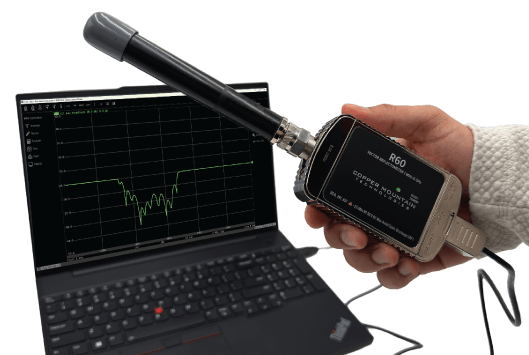
Copper Mountain Technologies offers a range of compact 1-port VNAs covering frequencies up to 6 GHz and 15 GHz, along with a full portfolio of multiport instruments, calibration solutions, and test accessories. A comprehensive library of technical resources, including white papers, webinars, and application notes, is also available to support engineers in optimizing their measurement systems.
1-port VNAs provide a highly effective solution for RF production environments where reflection measurements dominate. By aligning measurement capability with actual production requirements, these instruments enable a more efficient and scalable approach to testing.
The combination of simplified architecture, fast measurement speed, and seamless automation makes it possible to significantly increase throughput while maintaining high levels of accuracy and repeatability. When deployed in parallel configurations, 1-port VNAs offer a level of performance that can exceed traditional multiport systems for reflection-based measurements.
Copper Mountain Technologies offers a range of compact 1-port VNAs covering frequencies up to 6 GHz and 15 GHz, along with a full portfolio of multiport instruments, calibration solutions, and test accessories. A comprehensive library of technical resources, including white papers, webinars, and application notes, is also available to support engineers in optimizing their measurement systems.
Learn more about VNA

Manufacturing Test for Automated Measurements