

From RF Testing to Intelligent Sensing: Integrated Embedded VNA Solutions for S-Parameter Measurement
July 13, 2026Integrated and embedded VNA solutions are transforming the role of vector network analyzers from traditional RF test instruments into intelligent sensing platforms. This paper explores the technologies driving this transition and demonstrates how embedded S-parameter measurement is enabling a new generation of sensing systems across diverse applications. Although these applications span fields ranging from industrial monitoring and predictive maintenance to agriculture and medical technologies, they all rely on the same fundamental principle: physical changes alter electromagnetic behavior, and those changes can be measured, interpreted, and transformed into actionable information that supports better decisions.
For more than half a century, vector network analyzers (VNAs) have been indispensable tools for RF and microwave engineers. Their role has been well defined: characterize the electrical behavior of components and systems by measuring scattering parameters. Whether evaluating an antenna, filter, amplifier, cable assembly, or waveguide, the workflow has remained essentially unchanged. An engineer connects the device under test, performs a calibration, acquires S-parameter data, interprets the results, and makes an engineering decision. Once the measurement is complete, the instrument is disconnected until it is needed again.
Advances in RF instrumentation are fundamentally changing this model. Improvements in size, weight, power consumption, and cost (SWaP-C) have enabled VNAs to move beyond the laboratory and become permanently embedded within larger systems. Instead of serving as stand-alone test instruments operated by RF specialists, compact VNAs can now function as autonomous sensors that continuously monitor the electrical behavior of devices, materials, and environments without requiring human intervention.
This shift expands the role of S-parameter measurement far beyond traditional RF testing. The same electromagnetic interactions that reveal the performance of an antenna or transmission line also contain information about the physical properties of materials. Changes in moisture content, salinity, contamination, density, structural integrity, and biological tissue all alter the propagation, reflection, and absorption of microwave energy. Because S-parameters directly describe these interactions, they provide a powerful means of observing changes in the physical world.
The significance of this capability lies not in displaying increasingly sophisticated RF measurements, but in transforming those measurements into useful information. A maintenance technician does not need to examine a Smith chart to know that moisture has entered a radar waveguide. A farmer requires a map of soil moisture rather than a plot of reflection coefficient. A physician is interested in identifying abnormal tissue, not interpreting complex scattering parameters. In each case, the underlying electromagnetic measurements remain the same, but the information delivered to the user is fundamentally different.
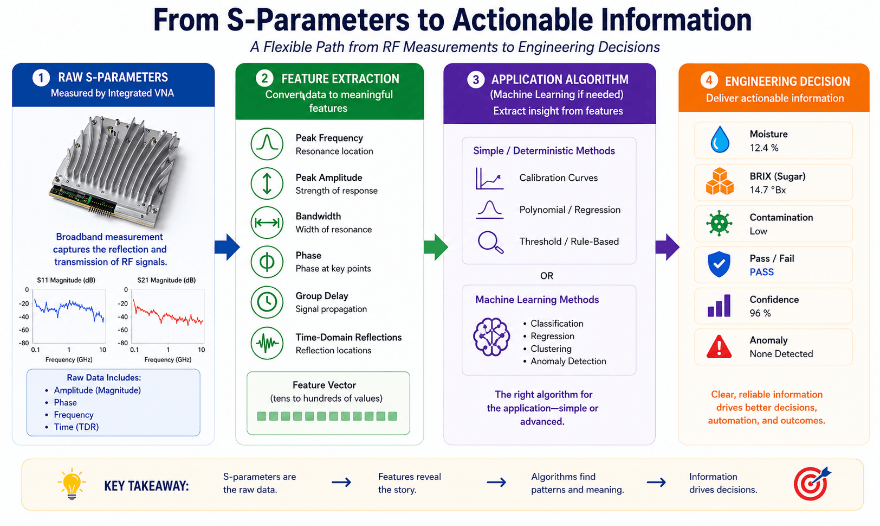
Figure 1 – VNA as a Sensor
Three technological developments have made this transformation possible. First, broadband frequency sweeps can be converted into spatial information using inverse Fourier-based techniques, allowing faults to be localized along cables and waveguides. Second, complete S-parameter spectra can be treated as electromagnetic fingerprints that characterize materials and physical states with far greater fidelity than single-frequency measurements. Finally, embedded computing and machine learning enable large collections of measurements to be analyzed automatically, revealing trends and patterns that support predictive maintenance and intelligent classification.
Together, these capabilities redefine the purpose of the vector network analyzer. Rather than serving solely as an instrument for RF characterization, the embedded and/or integrated VNA becomes a general-purpose electromagnetic sensing engine that operates continuously in the background, converting microwave measurements into actionable information. Applications range from predictive maintenance of antennas and radar systems to environmental monitoring, industrial process control, and emerging biomedical diagnostic techniques.
The Three Pillars of Integrated S-Parameter Measurement
The transition from the traditional laboratory vector network analyzer to an embedded sensing platform is driven by three complementary capabilities. Individually, each represents a significant advance in RF measurement technology. Together, they enable VNAs to evolve beyond component characterization and become intelligent electromagnetic embedded and/or integrated sensors that continuously monitor physical systems and convert microwave measurements into actionable information.
The first pillar is time-domain localization. Although a VNA fundamentally measures frequency-domain scattering parameters, broadband measurements can be transformed into the time domain [4] using an Inverse Discrete Fourier Transform (IDFT) or an Inverse Chirp-Z Transform (ICZT) [2,3]. The resulting response provides a spatial representation of reflections within the measurement path, allowing discontinuities to be localized with remarkable precision. A damaged connector, corroded waveguide flange, or region of moisture ingress within a coaxial cable appears not only as a change in return loss, but also at a measurable distance from the instrument. This capability allows maintenance personnel to identify both the existence and location of developing faults, significantly reducing troubleshooting time while enabling predictive maintenance strategies.
The second pillar is spectrum fingerprinting. Conventional RF measurements often focus on a single parameter, such as return loss at a particular frequency or the shift of a resonant peak. Embedded sensing applications instead exploit the information contained within the entire measured spectrum. Every material interacts with electromagnetic energy according to its dielectric constant, conductivity, geometry, and internal structure. These interactions produce a unique frequency response that can be viewed as an electromagnetic fingerprint. Rather than extracting a single measurement, modern embedded systems treat hundreds or thousands of amplitude and phase measurements as a high-dimensional feature vector describing the object under test. Whether evaluating hydraulic oil, agricultural products, biological tissue, or industrial chemicals, the complete S-parameter spectrum frequently contains far more information than any individual measurement point.
The third pillar is continuous monitoring and intelligent interpretation. Traditional VNA measurements represent isolated observations made during laboratory testing. Embedded VNAs, by contrast, may acquire measurements continuously over months or even years. This historical record transforms individual measurements into time-series data that reveal gradual changes long before failures become apparent. Combined with modern signal processing and machine learning algorithms, these data can identify trends, classify material states, recognize developing failure mechanisms, and estimate the remaining useful life of critical components. Instead of requiring an engineer to interpret Smith charts or insertion loss plots, the system delivers meaningful conclusions, such as identifying contamination, predicting antenna degradation, locating cable faults, or mapping variations in soil moisture.
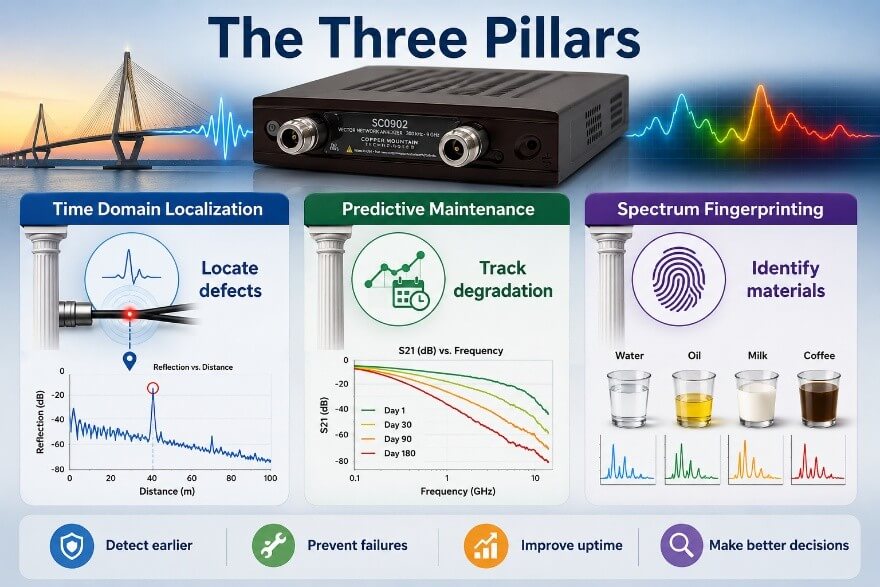
Figure 2 – Three Pillars.
These three capabilities reinforce one another. Time-domain processing reveals where a change has occurred, spectrum fingerprinting identifies what has changed, and continuous monitoring determines how that change is evolving over time. The result is a measurement system that extends far beyond conventional RF testing. Rather than serving solely as an instrument for characterizing electronic components, the embedded VNA becomes a persistent source of electromagnetic intelligence capable of observing the condition of materials, structures, and environments in real time.
The remainder of this paper illustrates how these three pillars form the foundation for a wide range of emerging applications, including predictive maintenance of RF infrastructure, environmental sensing, industrial process monitoring, and biomedical diagnostics. Although these applications span diverse disciplines, they all rely on the same fundamental principle: changes in the physical world produce measurable changes in electromagnetic behavior, and those changes can be quantified through broadband S-parameter measurements.
Predictive Maintenance Through Embedded VNAs
One of the earliest and most compelling applications of embedded vector network analyzers is predictive maintenance. Traditionally, RF systems are inspected only after a fault has degraded performance sufficiently to become noticeable. An antenna is tested after communication quality declines, a waveguide is examined after radar sensitivity decreases, or a cable assembly is replaced after intermittent failures begin to occur. This reactive approach often results in unnecessary downtime, higher maintenance costs, and, in critical systems, reduced operational readiness.
An embedded VNA fundamentally changes this maintenance philosophy. By permanently integrating a compact measurement engine into the RF system, antenna networks, transmission lines, and waveguides can be characterized automatically at regular intervals without requiring manual intervention. Because a complete broadband measurement requires only a fraction of a second, these health assessments can often be performed during scheduled idle periods without affecting normal operation.
The true value of these measurements lies not in any individual sweep, but in the ability to compare measurements acquired over weeks, months, or even years. Small changes that would be insignificant during a single inspection become obvious when viewed as long-term trends. A gradual reduction in antenna return loss may indicate corrosion, mechanical fatigue, or connector degradation. Likewise, a slowly increasing reflection within a waveguide may signal the early stages of moisture intrusion or gasket failure. Rather than identifying failures after they occur, embedded VNAs provide the opportunity to detect degradation while corrective action is still inexpensive and convenient.
Broadband measurements provide an additional advantage that is unavailable from simple reflected power monitors. By applying an inverse Fourier transform to the measured frequency response, the reflection coefficient can be displayed as a function of distance. The RF transmission path effectively becomes a map in which discontinuities appear at their physical locations. Maintenance personnel can therefore determine not only that a fault exists, but also approximately where it is located. A damaged connector, corroded flange, or water-filled section of coaxial cable can often be localized within the system before disassembly begins, dramatically reducing troubleshooting time.
This capability is particularly valuable in large or inaccessible RF installations. Military vehicles, commercial aircraft, radar systems, and remote communications sites all depend upon antennas and transmission lines that are exposed to vibration, thermal cycling, moisture, and mechanical stress throughout their service lives. Many of these degradation mechanisms develop gradually, producing measurable changes in impedance long before communication performance is noticeably affected. Continuous monitoring allows maintenance to be scheduled according to the actual condition of the equipment rather than fixed inspection intervals or unexpected failures.
As historical measurement databases grow, predictive maintenance becomes increasingly sophisticated. Statistical analysis and machine learning algorithms can identify patterns associated with specific failure mechanisms and distinguish normal aging from abnormal degradation. Instead of simply reporting that a reflection has increased, the system can recognize trends that suggest moisture ingress, corrosion, or mechanical damage and estimate when maintenance is likely to become necessary. The operator receives actionable information rather than raw RF measurements.
Viewed in this way, the embedded VNA is no longer simply a diagnostic instrument. It becomes a permanent health monitor for RF infrastructure, continuously evaluating system integrity and providing early warning of developing problems. The same measurement techniques that have long been used to characterize antennas and transmission lines in the laboratory can now operate autonomously in the field, improving reliability while reducing maintenance costs and unplanned downtime.
Spectrum Fingerprinting and Material Characterization
While predictive maintenance uses S-parameter measurements to monitor the health of RF infrastructure, the same measurement principles can be extended much further. Every material interacts with electromagnetic energy according to its electrical properties, including permittivity, conductivity, geometry, and internal structure. These interactions determine how microwave energy is reflected, transmitted, and absorbed across a range of frequencies. Because these properties vary from one material to another, the measured S-parameters contain far more information than simply the performance of an RF component. They provide a unique electromagnetic signature that can be used to characterize the physical state of the material itself.
Conventional microwave measurements often focus on a single parameter, such as the resonant frequency of a sensor or the return loss at one frequency. While these measurements can be highly effective, they exploit only a small fraction of the information available in a broadband frequency sweep. A modern vector network analyzer may acquire hundreds or thousands of complex data points in a single measurement, capturing both amplitude and phase over a wide frequency range. Collectively, these measurements describe how a material interacts with electromagnetic fields over an entire spectrum rather than at an isolated frequency.
This broadband response can be viewed as an electromagnetic fingerprint. Just as no two fingerprints are identical, different materials and physical conditions produce distinct spectral signatures. Moisture content, chemical composition, contamination, density, temperature, and structural changes all modify the dielectric properties of a material, producing measurable changes throughout the frequency response. Rather than searching for a single resonance shift, the complete S-parameter spectrum becomes the quantity of interest.
One example is the use of microwave resonant sensors to characterize liquids. A split-ring resonator [1] coupled to an embedded VNA produces multiple resonant modes, each sampling the dielectric properties of the material at a different frequency. Together, these resonances provide a much richer description of the material than any individual measurement. Liquids with similar behavior at one frequency often become distinguishable when their responses are compared across the entire measurement band. The resulting spectrum effectively serves as a unique electromagnetic identity that can be associated with specific material properties.
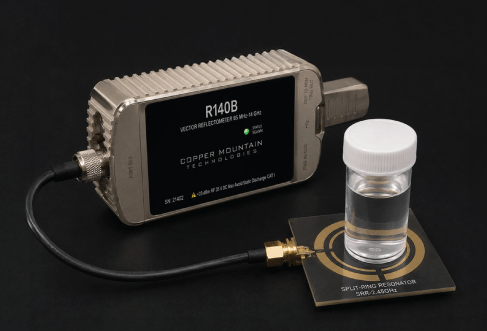
Figure 3 – Split Ring Sensor
The same principle applies across a wide range of sensing applications. Hydraulic oils gradually change dielectric properties as oxidation and contamination increase. Agricultural products exhibit predictable spectral variations as moisture content changes during growth and storage. Industrial chemicals can be monitored for concentration or purity, while food products may be evaluated for ripeness or spoilage without direct contact. In each case, the underlying measurement remains the same. The VNA records broadband S-parameters, while the material determines the shape of the measured spectrum.
Unlike traditional sensors designed to measure a single variable, spectrum fingerprinting provides a multidimensional description of the object under test. This allows a single sensing platform to distinguish among multiple physical states without requiring separate temperature, moisture, chemical, or conductivity sensors. As reference databases are developed, measured spectra can be compared against known signatures to classify materials or identify subtle changes that would be difficult to detect using conventional measurement techniques.
Machine learning further enhances this capability by recognizing complex relationships within large spectral datasets. Instead of relying on manually selected measurement points or threshold values, classification algorithms can analyze the complete feature vector represented by the broadband S-parameters. The system ultimately presents the user with meaningful information, such as identifying contamination, estimating moisture content, or classifying an unknown material, while the underlying electromagnetic measurements remain entirely transparent.
Spectrum fingerprinting therefore represents a fundamental shift in the role of the vector network analyzer. Rather than characterizing RF components alone, the instrument becomes a general-purpose sensor capable of observing the electromagnetic properties of virtually any material. When combined with embedded hardware, continuous monitoring, and automated data analysis, broadband S-parameter measurements provide a powerful foundation for intelligent sensing systems whose applications extend far beyond traditional RF engineering.
Environmental Monitoring with Mobile Embedded VNAs
The same broadband measurement techniques used to monitor antennas and characterize materials can also be applied to the natural environment. When combined with lightweight antennas, embedded computing, and unmanned aerial vehicles (UAVs), compact vector network analyzers become mobile sensing platforms capable of measuring the electromagnetic properties of the Earth’s surface over large areas. Rather than testing RF components, the VNA measures how the environment itself interacts with microwave energy.
Microwave sensing is particularly attractive because many naturally occurring materials exhibit large differences in their dielectric properties. Water, for example, has a dielectric constant that is dramatically higher than that of dry soil, vegetation, snow, or rock. As a result, variations in moisture content produce measurable changes in the reflected electromagnetic field. By transmitting a broadband microwave signal toward the ground and continuously recording the reflected S-parameters, an embedded VNA can detect subtle changes in surface composition that are invisible to optical or infrared imaging systems.
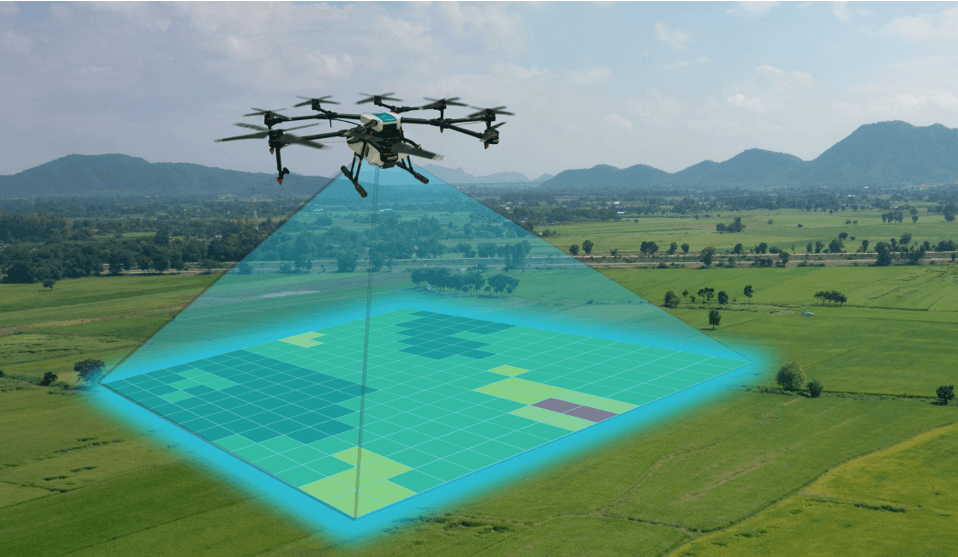
Mounted beneath a small drone, the embedded VNA becomes a mobile electromagnetic observatory. As the aircraft follows a programmed flight path, broadband reflection measurements are continuously acquired and tagged with GPS coordinates. The resulting data can be assembled into two-dimensional maps that reveal spatial variations in dielectric properties across an entire field or survey area. Unlike fixed sensors that provide measurements only at isolated locations, a mobile platform can rapidly characterize large regions while maintaining high spatial resolution.
Precision agriculture provides a particularly compelling example. Soil moisture often varies significantly across relatively short distances due to drainage patterns, soil composition, and topography. These variations directly influence crop growth, irrigation requirements, and fertilizer efficiency. Broadband microwave measurements can identify regions of excessive or insufficient moisture, allowing irrigation systems to deliver water only where it is needed. The result is improved crop management while reducing both water consumption and nutrient runoff.
Figure 4 – UAV Mounted VNA
The same measurement architecture can support a wide range of environmental monitoring applications. Snowpack behaves as a layered dielectric medium whose electrical properties evolve as snow accumulates, compacts, and melts. Broadband microwave measurements can estimate snow depth and density, providing valuable information for avalanche forecasting and water resource management [6]. In coastal regions, repeated surveys can monitor the gradual intrusion of seawater into freshwater estuaries, where increasing salinity alters both dielectric constant and electrical conductivity. Similar techniques may be applied to wetlands, reservoirs, and agricultural waterways to monitor changing environmental conditions over time.
The value of these systems lies not only in the measurements themselves but also in their ability to build historical records. Repeated surveys allow long-term changes to be identified, revealing trends that may not be apparent from a single observation. Seasonal variations, the effects of irrigation practices, or the progression of saltwater intrusion can all be monitored using the same embedded sensing platform. When combined with geographic information systems and other environmental data, broadband S-parameter measurements become an important source of information for resource management and scientific research.
These applications illustrate how far the role of the vector network analyzer has expanded beyond its traditional laboratory function. The underlying measurement remains the acquisition of S-parameters, but the objective is no longer to evaluate RF hardware. Instead, the VNA becomes a remote sensing instrument that observes the electromagnetic properties of the environment, transforming broadband microwave measurements into information that supports agriculture, environmental stewardship, and infrastructure planning.
Biomedical Applications
Perhaps the most promising long-term application of embedded S-parameter measurement lies in biomedical sensing. Like industrial materials and environmental media, biological tissues possess unique dielectric properties that determine how they interact with electromagnetic energy. Variations in water content, cellular structure, blood flow, and tissue composition all influence the propagation and scattering of microwave signals. As a result, broadband S-parameter measurements can provide information about physiological conditions without exposing patients to ionizing radiation.
This principle has motivated significant research into microwave imaging systems that employ arrays of antennas surrounding the region of interest. Low-power microwave signals are transmitted through the body while neighboring antennas record the scattered fields over a broad frequency range. The resulting S-parameters can then be processed using image reconstruction algorithms to estimate the spatial distribution of tissue dielectric properties. Unlike conventional medical imaging systems, compact microwave instrumentation offers the possibility of portable, relatively low-cost diagnostic devices that could be deployed in ambulances, emergency departments, or remote healthcare settings.
One particularly promising application is the rapid assessment of stroke [9,10]. Ischemic and hemorrhagic strokes produce different changes in the electrical properties of brain tissue, making them potentially distinguishable through microwave measurements. Early identification of stroke type is critical because the treatments differ substantially, yet access to CT or MRI imaging may not always be immediately available. Compact microwave imaging systems could eventually provide clinicians with a rapid, portable method for triaging patients before they reach a hospital or while conventional imaging resources are being prepared.
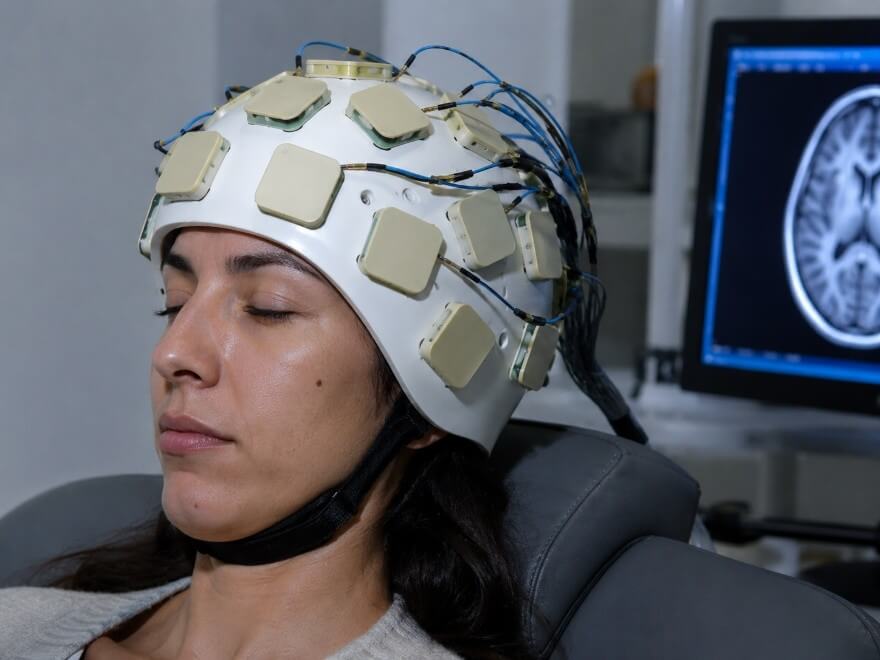
Figure 5 – Stroke Detection
The medical potential of broadband S-parameter measurements is already being demonstrated in breast imaging [7,8]. Commercial systems such as the MamoWave® breast imaging device use non-ionizing microwave measurements to characterize the dielectric properties of breast tissue without breast compression or X-ray exposure. Rather than replacing established imaging modalities, these systems illustrate how broadband electromagnetic measurements can provide clinically useful diagnostic information in a compact, patient-friendly platform. Their emergence represents an important milestone in the evolution of microwave sensing from research laboratories to real-world medical practice.
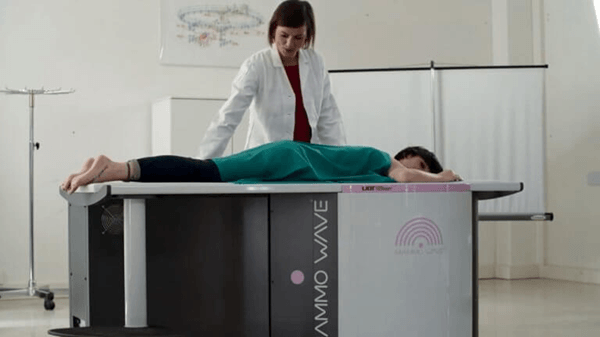
Figure 6 – MamoWave® System
Designing with Embedded VNAs: A New Approach to Sensing
The examples presented in this paper span an unusually broad range of disciplines, from monitoring military communication systems and industrial equipment to characterizing materials, mapping agricultural fields [5], and supporting emerging medical technologies. At first glance these applications appear unrelated. In reality, they are all manifestations of the same fundamental principle: every physical system interacts with electromagnetic energy, and those interactions can be measured through broadband S-parameters.
For many years, the primary purpose of a vector network analyzer was to characterize RF hardware. Embedded implementations expand that role considerably. Once broadband measurements can be acquired automatically, archived continuously, and interpreted using modern signal processing techniques, the VNA becomes much more than a test instrument. It becomes a general-purpose electromagnetic sensor capable of observing changes in materials, structures, and environments that would otherwise remain invisible.
This shift has important implications for system designers. Rather than asking how a VNA can be incorporated into a test station, engineers can begin asking what physical phenomenon they wish to observe. If that phenomenon influences the propagation of electromagnetic energy, an embedded VNA may provide the foundation for a practical sensing solution. The measurement itself remains the acquisition of S-parameters; only the interpretation changes.
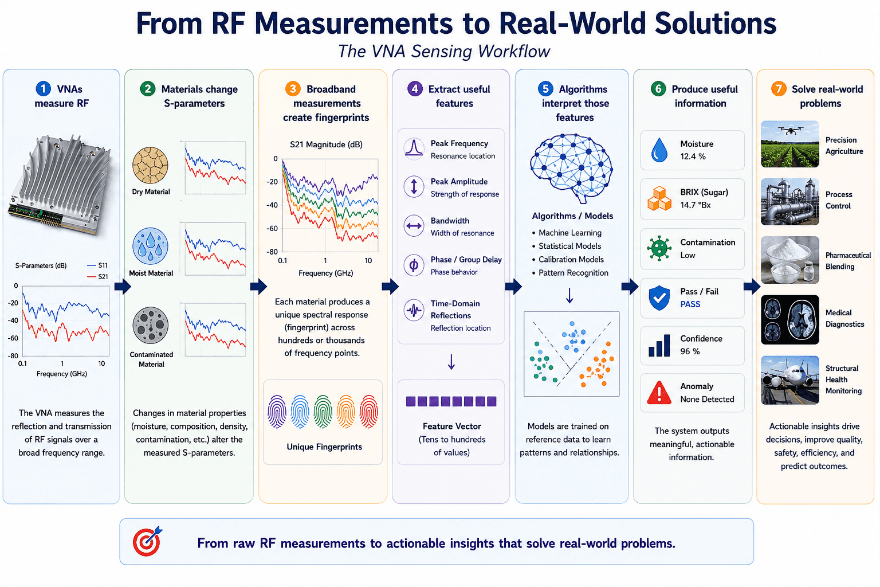
Figure 7 – Real World Solutions
As embedded computing, wireless connectivity, and machine learning continue to advance, this approach is likely to become increasingly common. Future systems may routinely perform thousands of microwave measurements each day without human intervention, quietly monitoring infrastructure, manufacturing processes, environmental conditions, and medical devices while delivering only the information that users need to make informed decisions.
The vector network analyzer will always remain an essential tool for RF engineers. Increasingly, however, it is also becoming something else: a versatile sensing platform that extends the reach of microwave measurement well beyond the laboratory and into the physical world.
References
- Zhu, W., Baghelani, M., & Iyer, A. K. (2024). Dielectric spectrum extraction of liquids using noncontact microwave split ring resonator. IEEE Transactions on Microwave Theory and Techniques. Advance online publication. https://doi.org/10.1109/TMTT.2024.3386109
- Walker, B. (2024, April 19). The Inverse Chirp-Z Transform for VNA Time Domain Processing. Copper Mountain Technologies. https://coppermountaintech.com/inverse-chirp-z-transform-for-vna-time-domain-processing/
- Sukhoy, V. (2019). Generalizing the inverse FFT off the unit circle. Nature – Scientific Reports. https://doi.org/10.1038/s41598-019-50234-9
- Walker, B. (2024, February 22). VNA Time Domain Processing. Copper Mountain Technologies. https://coppermountaintech.com/time-domain-processing/
- Palazzi, V., Bonafoni, S., Alimenti, F., Mezzanotte, P., & Roselli, L. (2019, November 12). Feeding the World with Microwaves. IEEE Microwave Magazine, December 2019, 72-86.
- Jenssen, R. R., & Jacobson, S. K. (2021, July 2). Measurement of Snow Water Equivalent Using Drone-Mounted Ultra-Wide-Band Radar. Remote Sensing, 13(2610), 72-86. https://doi.org/10.3390/rs13132610
- MANDAL, S. K., & SAMADDER, S. K. (2021). A Comprehensive Study on Microwave Imaging System for Breast Cancer Detection and Confocal Microwave Imaging. EUROPEAN ACADEMIC RESEARCH, Vol. IX(Issue 8), 5269-5287.
- Wang, L. Microwave, Imaging and Sensing Techniques for Breast Cancer Detection. Micromachines 2023, 14, 1462. https://doi.org/10.3390 mi14071462
- Guo, R., Lin, Z., Xin, J., Li, M., Yang, F., Xu, S., & Abubakar, A. (2024). Three dimensional microwave data inversion in feature space for stroke imaging. IEEE Transactions on Medical Imaging, 43(4), 1365-1376. https://doi.org/10.1109/TMI.2023.333678
- Guo, R., Lin, Z., Xin, J., Li, M., Yang, F., Xu, S., & Abubakar, A. (2024). Three dimensional microwave data inversion in feature space for stroke imaging. IEEE Transactions on Medical Imaging, 43(4), 1365-1376. https://doi.org/10.1109/TMI.2023.3336788
Learn more about the VNA
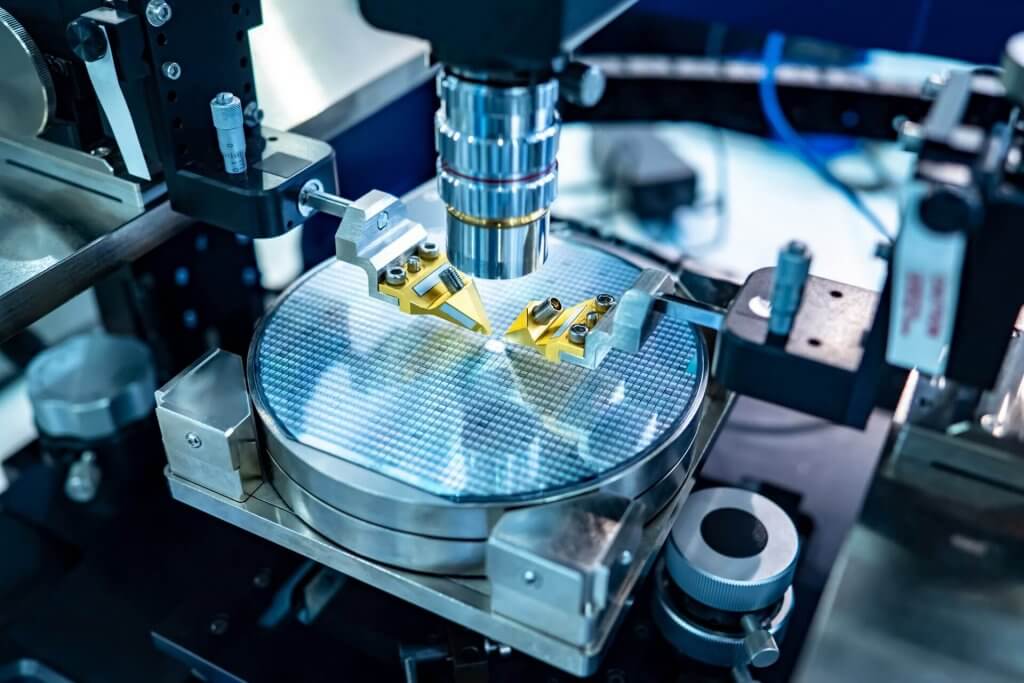
Manufacturing Test for Automated Measurements