Advantages of Running CMT VNA Software on ARM Platforms for Distributed RF Sensing
May 7, 2026Modern RF Test Architecture: ARM-Based VNA Systems
The ability to run Copper Mountain Technologies’ Vector Network Analyzer (VNA) software on ARM-based platforms such as the Raspberry Pi, BeagleBone, introduces significant flexibility and cost-efficiency in RF measurement systems. This paper explores the technical and operational advantages of this capability, including distributed sensing, IoT integration via MQTT, remote monitoring, and edge computing applications. The approach enables scalable, lightweight, and networked RF test environments suitable for aerospace, defense, telecom, and industrial IoT applications.
Traditional VNA systems often rely on embedded x86-based PCs for control and data processing. By enabling CMT VNA software to run natively in Linux on ARM processors, such as those in Raspberry Pi devices, engineers can deploy compact, low-power, and cost-effective RF measurement nodes. This capability aligns with modern trends in distributed sensing and edge computing.
Advantages of the ARM platform
- Linux offers the advantage of local administrative control compared to Windows-based systems and can be configured to achieve a very high level of security.
- ARM platforms such as BeagleBone and Raspberry Pi have integrated I/O and Wi-Fi capabilities, allowing integration into edge sensing and experimental systems
- ARM platforms are significantly less expensive than x86 Single Board or full-size computers
- Reduces the overall cost for large-scale deployments, such as sensor arrays or distributed RF monitoring ARM platforms fit well into size and power-constrained applications. Solar-powered applications are feasible
Could be fit into a radar application to periodically monitor antenna/radome performance
ARM-Based VNA Applications
The digital I/O available on Raspberry Pi and BeagleBone platforms enables a wide range of scientific and experimental applications. These digital I/O lines can be used to trigger external test instrumentation or to signal a Device Under Test (DUT) to advance to the next position on a conveyor system. A similar approach was used at CERN to monitor beam positioning in the accelerator.
A 2-port VNA can be integrated into an LMR system with separate transmit and receive antennas to continuously measure Tx-Rx isolation, feedline condition, and antenna health. A digital I/O line from the ARM-based SBC can be connected to the Remote Site Monitoring and Control System (RSMCS) to report pass or fail status to the remote site monitor.
In another application, a solar-powered system consisting of a 14 GHz 1-port VNA, such as the Copper Mountain Technologies R140B, and an ARM SBC might be used to monitor oil or water levels hundreds of feet down a vertical pipe. Time Domain Analysis is included as a standard feature, allowing this function to be implemented with minimal system complexity.
A battery-powered ARM-based SBC paired with a USB-powered 1-port VNA from Copper Mountain Technologies could be mounted on a drone to measure soil moisture in agricultural environments or to assess water salinity for detecting seawater intrusion into sensitive estuaries. Excessive upstream water extraction is a common contributor to this potentially damaging condition. As water availability declines in many regions, there is a growing need for precision agriculture techniques to maximize crop yield while minimizing water usage.
Several VNAs, usually 1-port, might be deployed in an industrial environment using an MQTT network [1].
What Is MQTT? A Quick Technical Introduction
Message Queuing Telemetry Transport (MQTT) is a lightweight, publish–subscribe protocol designed for low‑overhead, event‑driven telemetry in distributed systems. Rather than polling devices for readings, clients publish messages under hierarchical topics to a central broker (e.g., VNA/01/Reflection, Env/ShopA/Temp). Any consumer that subscribes to those topics receives the data as it’s produced. This architecture minimizes network traffic, scales cleanly as nodes are added, and supports resilient delivery with three Quality of Service levels (QoS 0/1/2) and optional persistent sessions for clients that may disconnect intermittently.
For sensor networks, MQTT’s simplicity is a strength: payloads are small and regular, the topic tree doubles as a namespacing scheme, and the broker becomes the single point for access control, buffering, and integration with analytics or SCADA.
Constructing a Deployment of CMT 1‑Port VNAs with ARM SBC Controllers Hardware Topology
Each measurement node consists of:
- CMT 1‑port VNA (e.g., a compact module for reflection measurements) connected via USB/Ethernet to
- ARM single‑board computer (SBC) (e.g., Raspberry Pi or similar) that runs:
- the CMT control software or driver interface,
- a lightweight data‑acquisition service, and
- an MQTT client publishing measurements to the site broker.
Nodes reside close to the measurement points (pipes, tanks, fixtures) to keep RF leads short and maintain measurement integrity, while the broker runs on a reliable host in the operations network or in a high‑availability pair.
Software and Data Flow
1. Acquisition & preprocessing (on SBC):
The SBC schedules sweeps or event‑based readings from the VNA, applies calibration vectors, and reduces data to compact descriptors—e.g., selected frequency points of Γ(f), scalar reflection magnitude, or time‑domain range estimates for level sensing.
2. Publish to broker:
The SBC’s MQTT client publishes only when a reading changes beyond a configured threshold or at a fixed heartbeat. Typical topics:
- VNA/01/Reflection/mag
- VNA/01/Reflection/phase
- VNA/02/TDR/distance
- VNA/01/Status/health
A site‑wide subscription to VNA/# captures all nodes.
3. Subscriptions & consumers:
Plant dashboards, analytics services, or alarm managers subscribe to specific topics (e.g., VNA/+/TDR/#) or to a higher level (e.g., VNA/#). QoS should match criticality, use QoS 1 for routine telemetry and QoS 2 for safety‑critical alarms needing exactly‑once delivery.
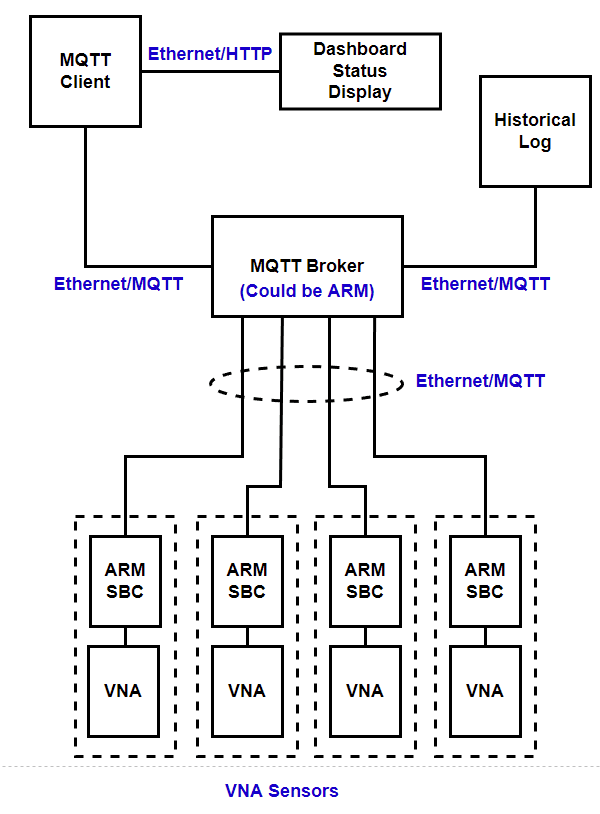
A deployed MQTT network might look like Figure 1.
Conclusion
Hardware Compatibility
The CMT VNA software is known to operate on an ARM-64 Raspberry Pi board running a Debian 13 based OS. Other SBCs in this general family that should operate well include:
- BeagleBone AI‑64 (aarch64)
- RockPro64 / Rock Pi 4 / Rock Pi 5
- ODROID N2+, ODROID M1
- Khadas VIM3/VIM4
- Pine64 boards
- Armbian‑supported aarch64 boards
Copper Mountain Technologies (CMT) is a leading supplier of vector network analyzers for industrial and scientific applications. Our product portfolio includes instruments that operate from 9 kHz to 22 GHz, with frequency extension options up to 330 GHz. CMT delivers innovative test and measurement solutions for a wide range of applications, including component and antenna testing, medical imaging, and agricultural and industrial sensing.
Contact our team to learn how we can support your specific measurement requirements.
Learn more about VNAs

Manufacturing Test for Automated Measurements